

The Ultimate Test
How Disaster Drills Forge El Paso’s Future Emergency Responders
By PJ Vierra, Ph.D.
In April 2025, Texas Tech Health El Paso transformed its campus into a high-stakes mass-casualty exercise, where future health care heroes faced their greatest test yet.
In a scenario where a chemical truck lost control and plunged into a community center, the life of “Lucy,” portrayed by a local volunteer, hung in the balance. She was one of 44 “victims” scattered across the crash site, many of whom suffered chemical burns, cuts and broken bones. But Lucy was a conundrum. She had no outward signs of injury but went in and out of consciousness.
The emergency teams quickly focused on the care and triage of Lucy and the other patients, arriving nonstop by ambulance from the crash site. The blaring sirens, cries of patients and sheer volume and variety of injuries would challenge the most seasoned professionals.
The participants, however, weren’t seasoned professionals. They were resident physicians and nursing students — health care professionals in the final stages of specialty training.
As paramedics placed a barcodeed triage band on Lucy’s arm and scanned it to track her journey from accident to recovery, the drill’s true purpose emerged.
This wasn’t just about technical skills - it was about forging the kind of decisive leadership that saves lives when hospitals flood with victims and chaos reigns supreme.
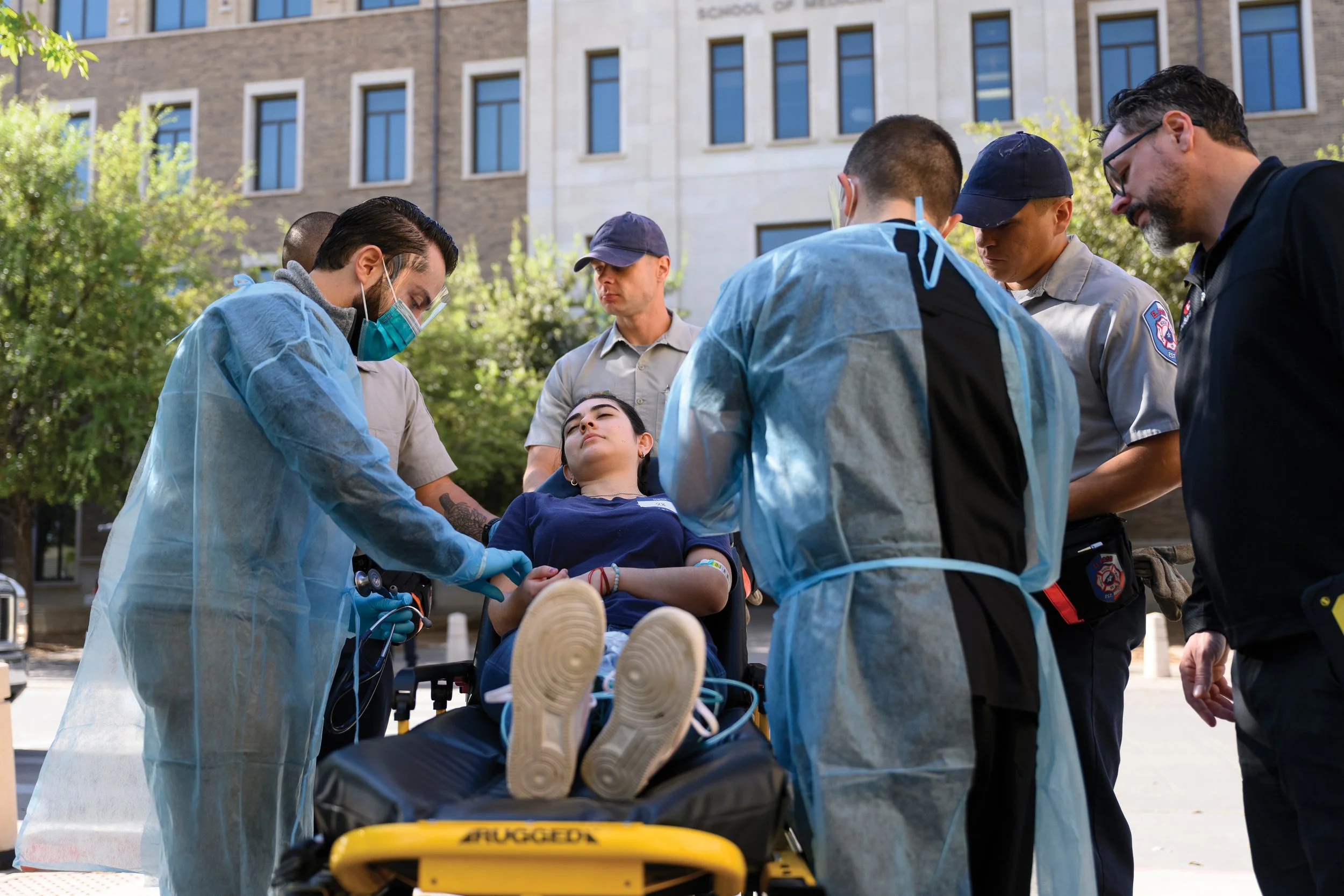
The residents waiting outside the Hunt School of Nursing for Lucy’s arrival had practiced for this moment. Decontamination showers stood ready to treat chemical exposure to chlorine and ammonia. Digital tablets displayed patient information, allowing responders to track the patient’s progress from the accident scene to triage and then to the emergency room. Meanwhile, faculty and staff observed the residents’ decision-making, offering feedback and guidance when necessary.

Sim Labs Mimic Real-World Challenges
Inside the Hunt School of Nursing, which served as the hospital, advanced simulation labs buzzed with activity. Here, the intensity reached fever pitch as some patients, now represented by high-fidelity medical manikins programmed to react in real time, were attended to by participants. Simulation managers in adjacent rooms manipulated vital signs, making them fluctuate unpredictably and forcing the team to adapt quickly.
The simulation’s realism was no accident. Scott Crawford, M.D., Director of the Training and Educational Center for Healthcare Simulation (TECHS), designed these exercises to push responders to their limits. Simulations test more than technical skills and medical knowledge - they foster human interaction among the emergency medicine team and patients.
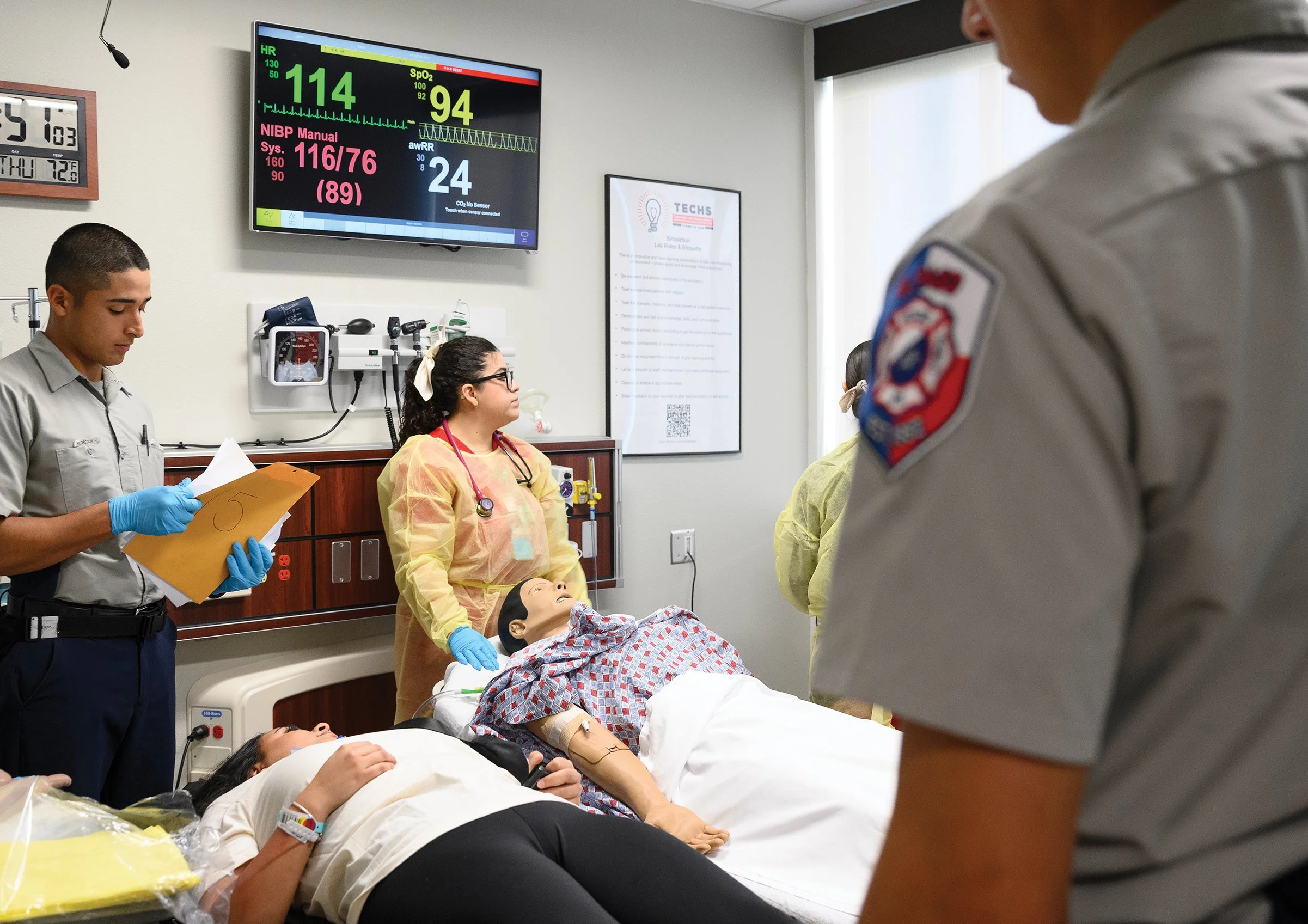
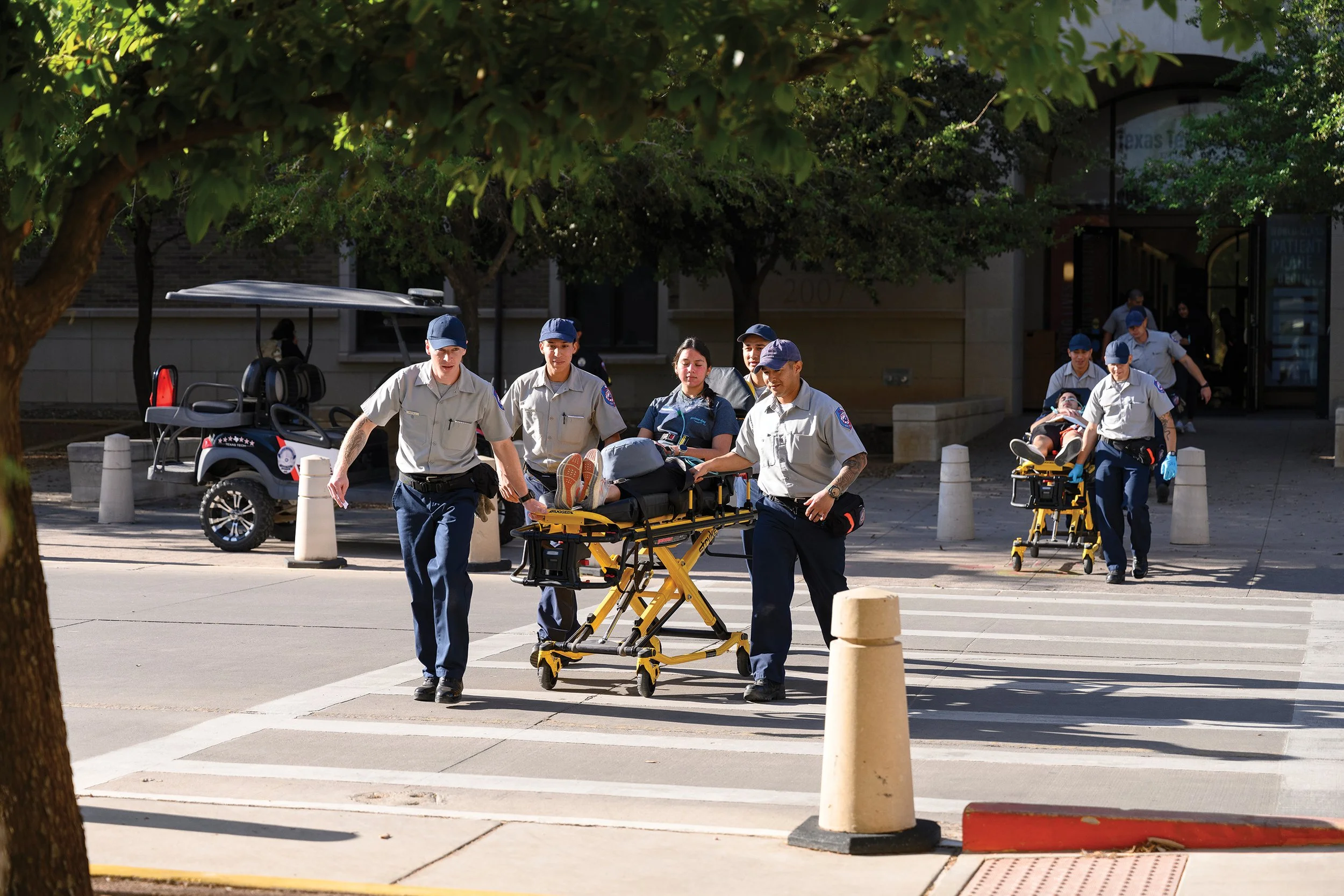
Top: Emergency medicine resident documents care as a simulated trauma patient arrives in the Hunt School of Nursing lab.
Top right: First responders mock casulaties on stretchers during a campus-wide disaster drill.
Bottom right: Nursing students treat a life-like high-fidelity manikin in a hospital simulation to practice rapid, team-based decisions.
Ready for the Unthinkable
In a mass casualty event, the overwhelming number of injuries occurs in its initial moments, creating an acute need for health personnel, medical supplies, blood and medicines.
Emergency medicine residents at Texas Tech Health El Paso complete disaster simulation training every 18 months.
Those participating in drills are part of over 330 medical residents, 250 nursing students and 470 medical students training at Texas Tech Health El Paso.
The 2019 El Paso Walmart shooting reinforced the critical need for such preparedness training.
Texas Tech Health El Paso Magazine, Fall 2025